 By Saifullah Alam
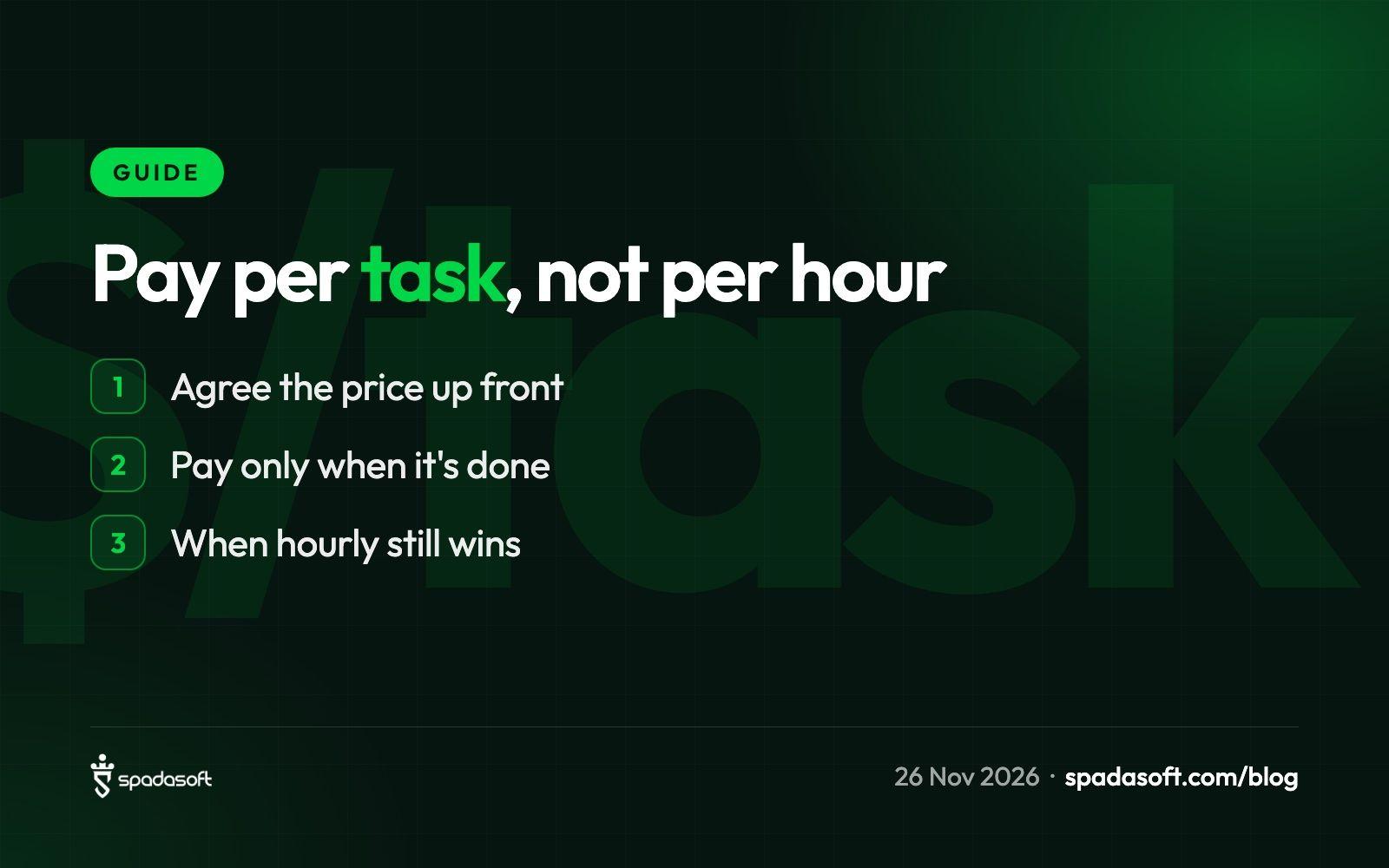
Most people who buy software work don't want to pay for effort. They want to pay for a result: a bug that stays fixed, a feature that works, an integration that keeps two systems in sync. Pay-per-task development is built around that.
The short version: with pay-per-task development, you describe a piece of work and what "done" looks like, agree a fixed price before anyone starts, and pay only when the task is done. It suits clear work you can check. For open-ended or ongoing work, an engineer paid by the hour or the month is still the better choice.
Software is already sold by the result
AI vendors moved first. In August 2024, Zendesk introduced outcome-based pricing for its AI agents, under which "customers will only incur costs for issues that are resolved autonomously by AI". Intercom charges $0.99 for each resolution by its Fin AI agent, and its help centre says: "You will never be charged for an outcome that didn't happen."
Once you've bought software that way, paying for engineering by the hour can feel backwards. For a lot of engineering work, it doesn't have to be.
Four ways to pay for engineering
- Hourly: you pay for time worked, and you carry the cost if the work takes longer. Best for part-time help and workloads that rise and fall. Watch out for a bill that grows when work overruns.
- Monthly (a dedicated engineer): you pay for a full-time engineer, and you carry the cost of overruns. Best for ongoing product work you direct day to day. Watch out for paying for capacity in quiet weeks.
- Fixed-price project: you pay for a whole project, specified up front, and the vendor carries the cost of overruns. Best for large builds with a stable specification. Watch out for long specs, change requests and surprises late on.
- Per task: you pay for each finished task, and the vendor carries the cost of overruns. Best for clear pieces of work with a result you can check. Watch out for vague tasks, or tasks too big to check in one go.
Per task sits between the last two. Like a fixed-price project, the vendor carries the risk of the work taking longer. Unlike one, you don't need to specify a whole project in advance: you buy one finished piece at a time, and you can stop after any task.
How pay-per-task development works
- Describe the task. What should change, and what "done" looks like. A few lines is usually enough.
- Get a fixed price. The developer quotes the task before any work starts, and you decide whether to go ahead.
- The work gets done. In your repository or theirs, as agreed.
- Check it, then pay. You test the result against the "done when" you agreed. The task is paid when it passes.
The "done when" line does the work a contract clause would. Get it right, and both sides know exactly what is being bought.
How to write a task that can be priced
Use five lines:
- Context: the product and stack. "Next.js app with a Node.js API and PostgreSQL. Stripe already handles one-off payments."
- What should change: one outcome. "Add monthly and yearly subscriptions, with upgrade, downgrade and cancel."
- Done when: how you'll check it. "A test user can subscribe, switch plan and cancel on staging, and the plan updates in our database."
- Constraints: what must not change. "Keep the existing checkout page. No new third-party services."
- Access: what the developer needs on day one. "Repository, staging environment, Stripe test-mode key."
Some "done when" lines for common tasks:
- Bug fix: the bug can't be reproduced, and a test covers it.
- Integration: the agreed records sync between the two systems in both directions.
- AI feature: answers pass a set of test questions you provide.
- Front-end work: the pages match the design on mobile and desktop.
- Performance: the page or query meets a speed you agree in advance.
- Upgrade: the app runs on the new version, with the existing tests passing.
What drives the price of a task
No two tasks cost the same, but the same things push the price up or down:
- Unknowns in the codebase. A task in well-tested code is cheaper to quote than one in code nobody has touched for years.
- Third parties. Payment providers, CRMs and other external APIs add set-up and testing time.
- How "done" is checked. A clear, testable "done when" lowers the price, because the developer doesn't need to build in a margin for an argument at the end.
- Access. Waiting days for credentials is time somebody has to pay for.
Mistakes to avoid
- Don't define "done" as "it works". Say how you'll check that it works.
- Don't bundle unrelated changes into one task. Two outcomes means two tasks, with two prices.
- Don't hold back access. A developer who can't reach staging can't prove the task is done.