
 By Saifullah Alam
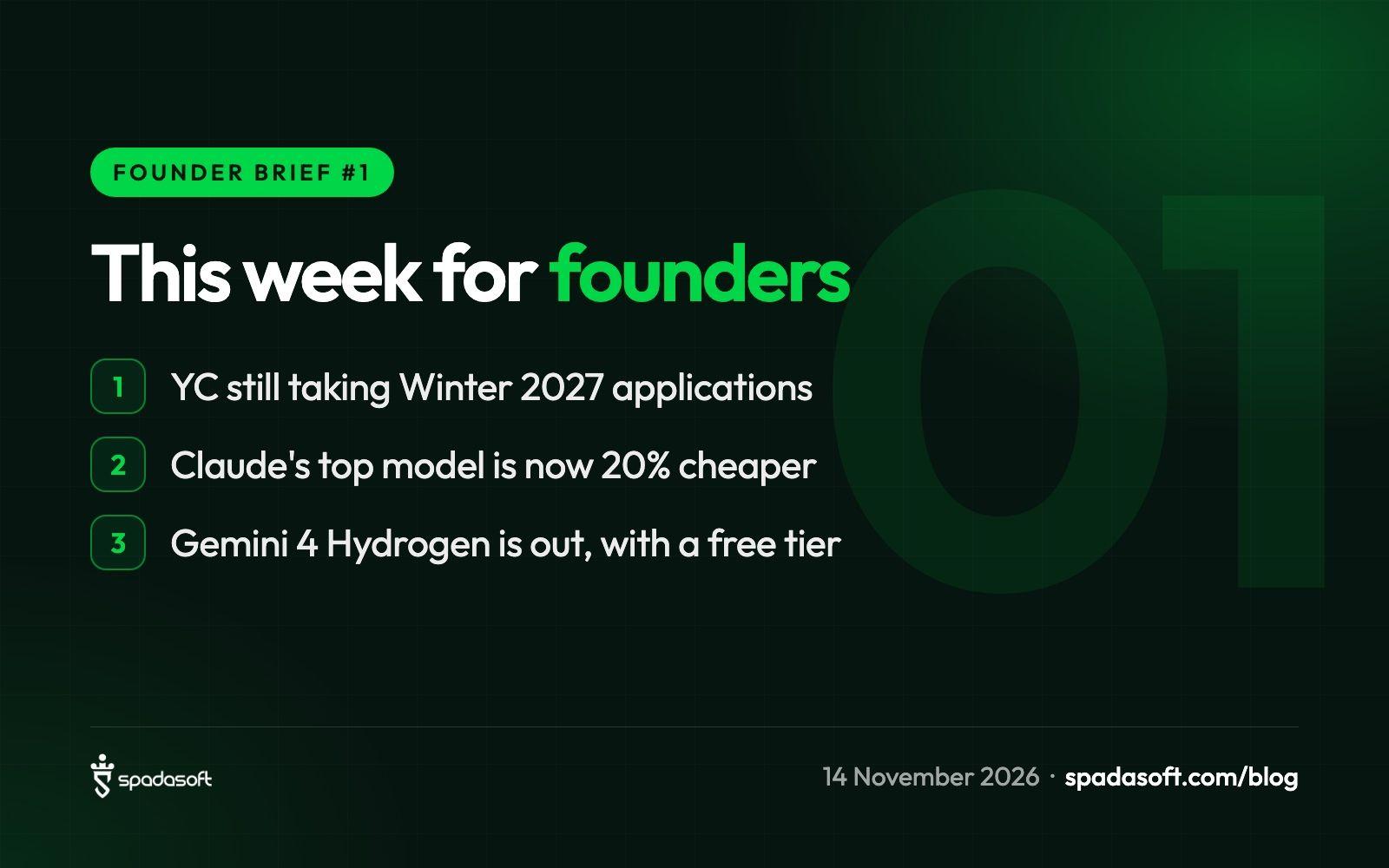
Five things from the week of 9–14 November 2026 that matter if you're building a startup with AI. Every fact links to the company's own announcement; each item ends with what it means for you.
1. YC is still taking Winter 2027 applications
Y Combinator's apply page says the on-time deadline passed on 2 November, but late applications are still accepted for the Winter 2027 batch, which runs from January to March in San Francisco. On-time applicants hear back by 11 December; YC says it will still consider late applications but can't promise when it will reply.
What it means for you: if you apply late, the product does more of the talking. A working MVP that real users have touched, even a narrow one, answers more questions than a pitch deck. If you're accepted, the batch is three months, so plan now how you'll add engineering capacity quickly.
2. Claude's most capable model is 20% cheaper
Anthropic released Claude Fable 5.2 on 9 November. Per its release notes, it costs $8 per million input tokens and $40 per million output tokens, down from $10 and $50 for Fable 5.1, with a 1M-token context window.
What it means for you: top-tier model prices keep falling, and they fall at different times for different providers. If your product calls one model directly from many places in the code, switching to take advantage costs a sprint. Put model calls behind one small internal interface, so changing model or provider becomes a configuration change.
3. You can now self-host Claude's agent service
On 12 November Anthropic launched self-hosted Claude Managed Agents: you run the agent service on your own infrastructure and store agents, sessions and session history there. Model requests go to Anthropic by default, or to a provider you choose. Access is through Anthropic's account team.
What it means for you: if you sell to banks, healthcare, or customers in the EU or the Gulf, "where does the agent's conversation history live?" is often the question that stalls a deal. Keeping session data in your own cloud makes that answer simpler. Note that model requests still go to a model provider.
4. Gemini 4 Hydrogen is generally available, with a free tier
Google made Gemini 4 Hydrogen generally available on 12 November: free tier available, paid pricing of $1.50 per million input tokens and $7.50 per million output tokens, and a new "xhigh" thinking level for harder tasks.
What it means for you: for everyday coding and agent work, a capable model on a free tier makes prototyping nearly free. Prototype on it, and measure cost per task before you choose a production model.
5. Google's Decisions API answers yes/no without writing text
On 11 November Google released the Decisions API and Gemini Decision 1. It makes calibrated yes/no, category and rubric decisions across text, images, audio, video and PDFs without generating output text.
What it means for you: many AI features start with a decision: is this ticket urgent, which tool should handle this request, does this document meet the rules? Using a dedicated decision step before calling a large model can cut both cost and response time.
What to do this week
If AI features are on your roadmap and you're not sure which of these changes matter for your product, Spadasoft's free AI Business Audit looks at your workflows and tells you where AI is worth building and where it isn't. Building an MVP before a YC interview? See how we approach MVP development.
Next week's brief: the AI and startup news that changes what founders should build.